Header mvo 1 scaled

News

De haij & van der wende Lawyers

Welcome to our news (blog) page. Please note that the content of our English-language blogs consists of automated translations from our original Dutch-language blogs. As a result, there may be errors or ambiguities caused by the automated translation process. If you have any questions or encounter any unclear information, please feel free to contact the author directly.

•
Lennart Hordijk
Lennart hordijk small
•
Dennis Oud
Dennis rond 200x200
•
Erwin den Hartog
Erwin rond 200x200
•
Fleur Huisman
Fleur 1
•
Petra Lindthout
Petra lindhout pf
•
Tessa Sipkema
Tessa rond 200x200
•
Gerard van der Wende
Gerard rond 200x200
•
Elke Hofman-Bijvank
Elke 1
•
Bas van der Eijk
Bas lawyer Rotterdam
•
Tim van Riel
Tim portret
•
Iris Keemink
Iris portret
•
Noa Bilogrevic
Noa Thumbnail
30 januari 2024
•
De Haij & van der Wende
Logo Haij Wende

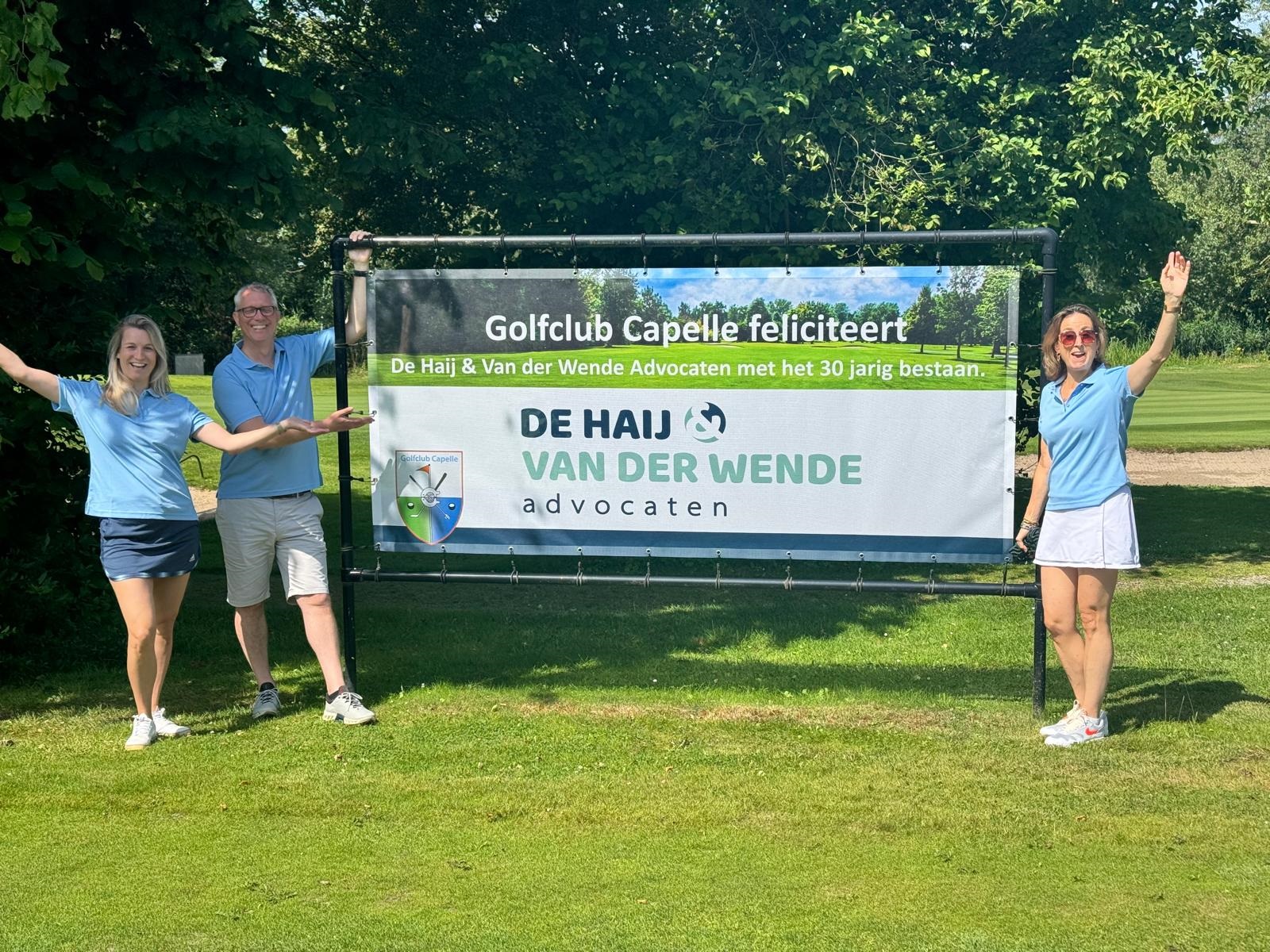
A look back at a wonderful anniversary golf day!⛳️

Bord op de green DO TS en MC

To mark our firm’s 30th anniversary, we organised a fully catered golf day for our clients on Tuesday 7 July – and what a fantastic day we had!

Everything fell into place: sunshine, a friendly group of participants, enjoyable flights and flawless organisation by Capelle Golf Club. What’s more, Restaurant Mulligan took care of every last detail, with delicious canapés, drinks and an extensive buffet. It was lovely to see how everyone struck up conversations, took to the course in good spirits and, above all, had a great time.

We look back on a more than successful day with pride and gratitude!

To everyone who was there: thank you for your presence and enthusiasm. You made this anniversary day unforgettable!

Here’s to many more wonderful years, valuable collaborations and lovely encounters!🎉

Team De Haij & Van der Wende Advocaten

•
Lennart Hordijk
Lennart hordijk small
•
Dennis Oud
Dennis rond 200x200
•
Erwin den Hartog
Erwin rond 200x200
•
Fleur Huisman
Fleur 1
•
Petra Lindthout
Petra lindhout pf
•
Tessa Sipkema
Tessa rond 200x200
•
Gerard van der Wende
Gerard rond 200x200
•
Elke Hofman-Bijvank
Elke 1
•
Bas van der Eijk
Bas lawyer Rotterdam
•
Tim van Riel
Tim portret
•
Iris Keemink
Iris portret
•
Noa Bilogrevic
Noa Thumbnail
30 januari 2024
•
De Haij & van der Wende
Logo Haij Wende

A previously granted environmental permit cannot be used for a subsequent expansion

Omgevingsvergunning paarden

On June 24, 2026, the Administrative Law Division of the Council of State issued an important ruling regarding the use of a previously granted environmental permit for a subsequent illegal expansion.

The facts of this case were as follows. In 2022, the Municipal Executive of De Ronde Venen granted the plaintiff an environmental permit for the construction of a barn to be used as a horse boarding facility. The barn was permitted to be 16 meters long. However, during an inspection in 2024, it was found that the barn was not 16 meters long, but 20 meters. Thus, the construction did not comply with the environmental permit that had been granted. The plaintiff submitted a new permit application to legalize the longer barn, but the municipal executive refused to grant the environmental permit.

The claimant’s objection and, later, his appeal to the district court were declared unfounded. Subsequently, the Division had to assess whether the municipal executive had rightly refused the environmental permit for the expansion.

The plaintiff argued that the municipal council had explicitly approved the use of the property as a horse boarding facility in 2022. The expansion of the barn from 16 to 20 meters would merely be a continuation of that already permitted use and would therefore be permitted under the 2022 environmental permit.

The Division disagreed. It ruled that the 2022 environmental permit applied only to the construction plan submitted at that time: a 16-meter barn to be used as a horse boarding facility. The environmental permit allowed for a deviation from the zoning plan but did not amend the zoning plan itself. Consequently, it did not create any possibility to carry out future expansions - in violation of the zoning plan - on the basis of that permit. After all, in 2022, that was not part of the plan for which the permit had been granted.

With this ruling, the Division has confirmed that the established case law under the Wabo on this matter also applies under the Environment Act. Thus, under the Environment Act as well, an environmental permit for an activity outside the zoning plan (BOPA) only grants permission to carry out the requested activity and therefore does not allow for future (illegal) expansions.

Do you have questions about expanding a structure or changing the use of your property, and what permits are required for that? Please contact Gerard van der Wende or me.

You can read the ruling here.

•
Lennart Hordijk
Lennart hordijk small
•
Dennis Oud
Dennis rond 200x200
•
Erwin den Hartog
Erwin rond 200x200
•
Fleur Huisman
Fleur 1
•
Petra Lindthout
Petra lindhout pf
•
Tessa Sipkema
Tessa rond 200x200
•
Gerard van der Wende
Gerard rond 200x200
•
Elke Hofman-Bijvank
Elke 1
•
Bas van der Eijk
Bas lawyer Rotterdam
•
Tim van Riel
Tim portret
•
Iris Keemink
Iris portret
•
Noa Bilogrevic
Noa Thumbnail
30 januari 2024
•
De Haij & van der Wende
Logo Haij Wende

New developments regarding bogus self-employment: practical considerations and rates are becoming increasingly important

Huurcontract scaled

A recent ruling by the Arnhem-Leeuwarden Court of Appeal once again demonstrates that employers must exercise caution when engaging self-employed individuals, interim professionals, and contractors through their own private limited company (B.V.).

In this case, a certified public accountant worked for an accounting firm through his own company. The parties had deliberately opted for a contract for services. Invoices included VAT, and the agreement explicitly stated that no employment contract was intended. It also stipulated that the worker could not later claim that an employment contract existed.

Nevertheless, the court ruled that an employment contract did exist.

In reaching this conclusion, the court did not focus on what the parties called the agreement, but rather on the agreed-upon rights and obligations and their actual implementation, considered in their mutual context. The accountant performed core tasks for the organization, worked full-time, was required to perform the work in person, had limited flexibility to work for other clients, and received a fixed monthly compensation. In addition, agreements had been made regarding, among other things, vacation days and the location where the work was performed.

These circumstances carried significant weight. According to the court of appeals, the fact that the parties themselves did not wish to enter into an employment contract was not a decisive factor. After all, the classification of an employment relationship is determined on the basis of the agreed-upon rights and obligations and the manner in which they are carried out.

It is noteworthy that the court also took into account that the worker himself had deliberately arranged for the arrangement through his private limited company and had derived a tax benefit from it. The court described his subsequent invocation of employee protection as unsympathetic and opportunistic. Nevertheless, this did not preclude the conclusion that an employment contract existed.

Because the working relationship was classified as an employment contract, the employer should not have terminated the agreement without the employee’s consent or authorization from the UWV. The employer was therefore ordered to pay compensation for wrongful termination, a transition payment, and equitable compensation.

However, the court of appeals did qualify the financial consequences. The agreed-upon assignment fee was not automatically equated with wages. According to the court, the fee also included elements related to the chosen assignment structure, such as flexibility and the absence of regular protection against dismissal. The court therefore established a lower gross monthly wage for the calculation of the compensation.

This ruling is part of a broader trend. Not only the courts but also the legislature are continuing to push for a reassessment of self-employed contractor relationships.

On June 16, 2026, the Senate approved the Act on the Introduction of a Legal Presumption of an Employment Contract Based on an Hourly Rate. The introduction of this legal presumption makes it easier for self-employed individuals who earn less than 38 euros per hour (as of January 1, 2026) to claim that they have an employment contract. 

If a self-employed person working below this threshold invokes this legal presumption, the burden of proof shifts. It is then up to the client to demonstrate that no employment contract exists. If the client fails to do so, the self-employed person can claim employee protections, such as continued wage payments and protection against dismissal.

It is important to note that no transitional provisions have been announced. The legal presumption will therefore also apply to existing agreements as of the law’s effective date. Organizations that work with lower-paid self-employed individuals would therefore be wise not to wait until the law formally takes effect.

The message is clear: a good contract remains important, but it is not enough. Look at the practical reality: what work is being performed, how independent is the contractor really, how regular is the work, how is payment made, and what instructions or organizational integration are in place?

The new legal presumption introduces an additional risk for low-wage self-employed individuals. Not only will the content of the agreement and its actual performance matter, but the hourly rate may also serve as the starting point for a discussion regarding employee status.

Do you have any questions? Please contact Dennis Oud, Tessa Sipkema, Noa Bilogrevic, or Elke Hofman-Bijvank. 

You can read the ruling here.

•
Lennart Hordijk
Lennart hordijk small
•
Dennis Oud
Dennis rond 200x200
•
Erwin den Hartog
Erwin rond 200x200
•
Fleur Huisman
Fleur 1
•
Petra Lindthout
Petra lindhout pf
•
Tessa Sipkema
Tessa rond 200x200
•
Gerard van der Wende
Gerard rond 200x200
•
Elke Hofman-Bijvank
Elke 1
•
Bas van der Eijk
Bas lawyer Rotterdam
•
Tim van Riel
Tim portret
•
Iris Keemink
Iris portret
•
Noa Bilogrevic
Noa Thumbnail
30 januari 2024
•
De Haij & van der Wende
Logo Haij Wende

No Compensation for Losses Following the Mayor's Order to Close a Hospitality Business

Sluiting horeca

The operator of a hospitality business in Amsterdam is not entitled to compensation for the damages she suffered during the temporary closure of her business premises ordered by the mayor. The Amsterdam District Court ruled as such in its decision of June 10, 2026.

The building housing the hospitality business was temporarily closed by the mayor after an explosive device detonated in front of the building in August 2022. The mayor closed the building due to a threat to public order and also based the decision on previous incidents involving the hospitality business and similar establishments.

The closure was lifted several months later at the request of the hospitality business’s operator, but by then the operator had already suffered significant damages as a result of the closure. The operator sought to recover the damages from the mayor. She therefore filed a claim for compensation for losses. The mayor rejected this claim, arguing that the damages fell within the scope of the operator’s normal business risk. The operator disagreed and filed an appeal with the Amsterdam District Court. She contended that the closure was unforeseeable and therefore could not be considered part of normal business risk. Furthermore, she could not be held responsible for the explosion, as, in her view, no connection could be established between the explosion and the business.

The court did not agree with the operator’s arguments. According to the court, a temporary closure of a hospitality business (or its premises) due to disturbances of public order is part of the normal business risk. A key factor in this was that the hospitality business is located in an area with residential properties and a hotel, and the explosion therefore caused a serious disturbance of public order. The mayor’s subsequent decision to close the premises was a normal and expected response, making the measure foreseeable. 

The fact that the catering business was not at fault for the explosion did not alter this conclusion. Even when a business owner has not personally done anything wrong, the business owner may still be liable for damages if those damages result from risks associated with the operation of the business. Operating a hospitality business, especially in an area where residential properties are also located, entails certain safety and public order risks. 

It follows from this ruling by the Amsterdam District Court that damages resulting from the lawful closure of a (hospitality) business due to a disturbance of public order are, in principle, not eligible for compensation if such damages fall within the scope of normal business risk. In this regard, the foreseeability of the closure is of particular importance. If closure is a normal and foreseeable response, the resulting damages will normally remain the responsibility of the hospitality business. 

You can read the ruling here.

•
Lennart Hordijk
Lennart hordijk small
•
Dennis Oud
Dennis rond 200x200
•
Erwin den Hartog
Erwin rond 200x200
•
Fleur Huisman
Fleur 1
•
Petra Lindthout
Petra lindhout pf
•
Tessa Sipkema
Tessa rond 200x200
•
Gerard van der Wende
Gerard rond 200x200
•
Elke Hofman-Bijvank
Elke 1
•
Bas van der Eijk
Bas lawyer Rotterdam
•
Tim van Riel
Tim portret
•
Iris Keemink
Iris portret
•
Noa Bilogrevic
Noa Thumbnail
30 januari 2024
•
De Haij & van der Wende
Logo Haij Wende

The Board wrongly ruled on the objection to the amendment permit

Omgevingsvergunning legalisatie

In most cases, the municipal executive is the competent authority responsible for deciding on building permit applications. However, there are also cases in which it lacks the authority to make such decisions.

This was the case in the ruling by the Administrative Law Division of the Council of State on June 3, 2026. The ruling concerned a home expansion in Middelburg. The municipal executive had granted an environmental permit for that expansion in 2022. An objection was filed against that permit without success, and the objector subsequently appealed to the district court. Ultimately, the case reached the Council of State. While those proceedings were still ongoing, the homeowner applied for a permit for a minor modification to the building plan, as it turned out that a part of the home had been built in deviation from the permit. That modification permit was granted in 2024. An objection was filed against the amendment permit. That objection was handled by the municipal executive in the usual manner and ultimately declared unfounded. The court reviewed the decision on the objection (also) on its merits and subsequently ruled that the decision on the objection was insufficiently substantiated.

Subsequently, the person who had objected to the amendment permit appealed to the Council of State. The Council of State heard the appeals against both the original permit and the amendment permit simultaneously at a hearing.

Regarding the amendment permit, the Council of State ruled that the municipal executive should not have made any decision on the objection at all. The amendment to the building plan (to which the amendment permit related) was of a minor nature. Because an appeal was still pending against the original permit, the municipal executive should have forwarded the objection to the Council of State pursuant to Article 6:109 of the General Administrative Law Act (Awb) to be assessed in the ongoing proceedings. Because the municipal executive nevertheless decided on the merits of the objection itself, it acted without authority. The Council of State therefore annulled the decision on the objection.

The Council of State also issued an important ruling regarding the applicable legislation. The original permit from 2022 logically still fell under the old legislation. Although the amendment permit was granted in 2024 and therefore after the Environmental Act came into effect, because the permit is considered part of or an amendment to the original permit, the proceedings against the amendment permit must also be handled under the old legislation.

In a permit procedure, it is therefore important to know the difference between a substantial and a minor amendment and to always verify which legislation applies.

Do you have questions about a (amendment) permit procedure? Please contact Gerard van der Wende or me.

You can read the ruling here.

•
Lennart Hordijk
Lennart hordijk small
•
Dennis Oud
Dennis rond 200x200
•
Erwin den Hartog
Erwin rond 200x200
•
Fleur Huisman
Fleur 1
•
Petra Lindthout
Petra lindhout pf
•
Tessa Sipkema
Tessa rond 200x200
•
Gerard van der Wende
Gerard rond 200x200
•
Elke Hofman-Bijvank
Elke 1
•
Bas van der Eijk
Bas lawyer Rotterdam
•
Tim van Riel
Tim portret
•
Iris Keemink
Iris portret
•
Noa Bilogrevic
Noa Thumbnail
30 januari 2024
•
De Haij & van der Wende
Logo Haij Wende

Illness while abroad & wage freeze

Zieke werknemer buitenland

In principle, an employee who is sick is entitled to continued pay. However, in return, certain obligations are expected of a sick employee. He or she must cooperate with medical examination requirements, be available to the company doctor, and make an effort toward recovery and reintegration.

A recent ruling by the Amsterdam District Court clearly illustrates how important these obligations are, especially when an employee is staying abroad while on sick leave.

This case involved an employee who reported sick while staying in Israel. The employer, D-Pers, had an absence protocol that clearly outlined what an employee must do in the event of illness while abroad. Among other things, the employee was required to provide her address of residence, submit medical information, and clarify whether she was able to travel or perform suitable work.

According to the employer, this was not done sufficiently. The employee remained in Israel for an extended period, while the company physician deemed that an examination and further guidance were necessary to assess her work capacity and reintegration options. Due to her stay abroad, these examinations were delayed or did not get off the ground (properly).

The employee claimed that she could not return to the Netherlands, but she failed to provide sufficient evidence to support this claim. In addition, she indicated that she had a social safety net in Israel. The court did not consider this a circumstance for which D-Pers should be held responsible. The employee could have been expected to remain readily available, to seek adequate treatment for her symptoms, and to make active efforts to facilitate her reintegration. According to the court, she had failed to do so sufficiently.

Furthermore, the employer had first issued a warning to the employee and only then suspended her wages. The UWV had also concluded in a Medical Expert Opinion that the employee’s reintegration efforts had been insufficient. All things considered, the judge therefore found it plausible that the wage suspension had been applied correctly.

This ruling demonstrates that a proper absence protocol is not merely a paper formality. Especially in cases of illness abroad, it is important to have clear rules in place beforehand and to follow them properly. What must the employee report? What medical information is required? When is the employee expected to return? And how can the employee remain reachable for the company doctor and other experts?

Questions about reintegration or your absence protocol? Please contact Dennis Oud, Elke Hofman-Bijvank, Noa Bilogrevic or with me.

You can read the ruling here

Stay informed

Sign up for our newsletter